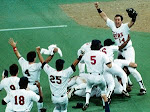


 JJ Hardy will replace Orlando Cabrera at shortstop for the Minnesota Twins next season. Baseball can be very cruel. Game 163 hero one moment to unemployed the next moment. I know, Cabrera's 35 years old now. His range at shortstop was an issue along with his arm, but I grew to enjoy watching Orlando Cabrera play baseball. He came to a team that took pride in their vanilla personality and interjected a dose of enthusiasm and plain old fun. His laughter on the field was a welcome sight because it broke up the business atmosphere that permeates most games. In addition and most amazing, Cabrera could actually make Carlos Gomez stop talking on the bench and listen simply because Cabrera never stopped talking himself. He was light hearted, a very entertaining interview and a team leader in the clubhouse. It can't be forgotten that Orlando Cabrera did contribute greatly to the Twins winning the division. His bat came alive down the stretch. He rarely walked, but batted .286 in September and a blistering .440 in twenty-five October at bats. Game 163 had him doubling off Curtis Granderson late in the game to save Joe Nathan and the team and he also hit a big home run to put the Twins up briefly in the 7th inning. I know having a 35 year old shortstop would be a poor baseball decision, but I'll miss the flavor Orlando Cabrera brought to the Twins in 2009.
Saturday, November 7, 2009
Orlando Cabrera Will Be Missed
JJ Hardy will replace Orlando Cabrera at shortstop for the Minnesota Twins next season. Baseball can be very cruel. Game 163 hero one moment to unemployed the next moment. I know, Cabrera's 35 years old now. His range at shortstop was an issue along with his arm, but I grew to enjoy watching Orlando Cabrera play baseball. He came to a team that took pride in their vanilla personality and interjected a dose of enthusiasm and plain old fun. His laughter on the field was a welcome sight because it broke up the business atmosphere that permeates most games. In addition and most amazing, Cabrera could actually make Carlos Gomez stop talking on the bench and listen simply because Cabrera never stopped talking himself. He was light hearted, a very entertaining interview and a team leader in the clubhouse. It can't be forgotten that Orlando Cabrera did contribute greatly to the Twins winning the division. His bat came alive down the stretch. He rarely walked, but batted .286 in September and a blistering .440 in twenty-five October at bats. Game 163 had him doubling off Curtis Granderson late in the game to save Joe Nathan and the team and he also hit a big home run to put the Twins up briefly in the 7th inning. I know having a 35 year old shortstop would be a poor baseball decision, but I'll miss the flavor Orlando Cabrera brought to the Twins in 2009.

Thursday, October 29, 2009
Minnesota Twins Greatest Offensive Season #46: Tony Oliva 1966

Tony Oliva's 1966 Season
AB: 622 (3rd in AL)
Hits: 191 (1st in AL)
Doubles: 32 (4th in AL)
Triples: 7
Home Runs: 25
RBI: 87 (10th in AL)
BB: 42
K: 72
BA: .307 (2nd in AL)
OBP: .353 (9th in AL)
SLG: .502 (6th in AL)
OPS: .854 (6th in AL)
OPS+: 136 (46th best in team history)
In 1966 The Twins were unable to repeat their World Series run of the previous season and finished a disappointing 89-73 in second place and nine games behind the Baltimore Orioles. Only two Twins batted over .260 in 1966: Harmon Killebrew at .281 and Tony Oliva with .307. Despite ranking high in many of the American League statistical categories and leading the AL in hits for the third year in a row, Oliva slumped mightily down the stretch. He took a batting average in the .320s into August, but endured a 5 for 41 slump in August. 1966 was another year of personal accolades for Oliva. He won his first and only Gold Glove of his career for his play in right field, he was a member of the American League All Star team and came in 6th in the MVP voting.
Tuesday, October 27, 2009
Minnesota Twins Greatest Offensive Season #47: Bob Allison 1967

Bob Allison's 1967 Season
AB: 496
Hits: 128
Doubles: 21
Triples: 6
Home Runs: 24 (7th in AL)
RBI: 75
BB: 74 (7th in AL)
K: 114 (6th in AL)
BA: .258
OBP: .356 (10th in AL)
SLG: .470 (7th in AL)
OPS: .826 (9th in AL)
OPS+: 135 (47th best in team history)
Involved in one of the closest pennant races of all time the Minnesota Twins finished second one game behind the Boston Red Sox with a 91-71 record in 1967. The statistics right handed batter Bob Allison put up in 1967 may not seem that remarkable in the offense orientated era baseball currently finds itself in, but they stand out in Twins' history. The Twins as a team in 1967 batted .240 and that was third best in the American League behind Detroit at .243 and Boston with .255. The average American League team batting average in 1967 was .236, a far cry from the AL average of .267 for 2009. 1967 was close to the bottoming out for hitters or the pinnacle for pitchers depending on how you look at it. In 1968 the American League average for batting was .230 and the result was the mound was lowered to reduce some of the advantage pitchers had and the strike zone was reduced. All of these considerations need to be looked at when analyzing Bob Allison's terrific 1967 season. Bob Allison retired after the 1970 season and unfortunately later contracted ataxia, a neurological disorder that affects muscle coordination. He died in 1995 at 60 years of age. Following his death, the Minnesota Twins created the Bob Allison Award for the Twins player who best exemplifies determination, hustle, tenacity, competitive spirit and leadership both on and off the field.
Sunday, October 25, 2009
Minnesota Twins Greatest Offensive Season #48: Justin Morneau 2009
 Justin Morneau's 2009 season:
AB: 508
Hits: 139
Doubles: 31
Triples: 1
Home Runs: 30
RBI: 100
BB: 72
K: 86
BA: .274
OBP: .363
SLG: .516
OPS: .879
OPS+: 135 (48th best in team history)
Despite batting just .201 in 174 at bats after the All Star break Justin Morneau still had the 48th best season at the plate in team history. Fans may disagree since they can still recall many disappointing at bats Morneau had in the second half of the season in addition with his missing the last three weeks of the season with a stress fracture in his back. With that said, his first half statistics are what carries his season into the top 50 in team history. In that first half Morneau batted: .311/.390/.575 with 21 home runs, 70 RBI and 44 walks. Fans are looking for Justin to put together two halves of a season that each look similar to the first half of the 2009 season.
Wednesday, October 21, 2009
Minnesota Twins Greatest Individual Offensive Season #49: Earl Battey 1963
 Earl Battey's 1963 season:
AB: 508
Hits: 145
Doubles: 17
Triples: 1
Home Runs: 26
RBI: 84
BB: 61
K: 75
BA: .285
OBP: .369
SLG: .476
OPS: .845
OPS+: 134 (49th best in team history)
The 1963 Minnesota Twins hit 225 home runs, which was the highest total in the history of baseball to that point. The team finished in 3rd place with a 91-70 record 13 games out of first place. Earl Battey will be remembered as the first catcher in Twins history. He played in 805 of the Twins' first 970 games. The 1963 season is Battey's only appearance in the top 50 hitting seasons in team history. In 1963 he was an All Star and came in 7th in the MVP voting. In his career Battey was a 3 time Gold Glove winner and 4 time All Star. In the 1965 All Star game at Metropolitian Stadium he received the most votes of any American League All Star. Author Jim Thielman, in his book The Cool of the Evening which details the 1965 season for the Twins, said, "Battey was one of the first players to use an ear-flap on his batting helmet to protect his face. He twice suffered broken cheekbones when hit by pitches, so he began wearing the special batting helmet in 1962. Today, all players wear such helmets." He played with the Twins until he was released in November of 1967. Earl Battey died on November 15, 2003 at the age of 68 from cancer.
Tuesday, October 20, 2009
Ranking the Top 50 Individual Offensive Seasons by a Minnesota Twin
 With the inaugural season at Target Field next year what has been rarely mentioned is that next year will be the 50th season of Minnesota Twins baseball. Many outstanding players have put on the varied uniforms of the Twins over the years, but I felt it was worth exploring who has had the 50 greatest performances in a season at the plate as a Minnesota Twin since 1961. How did I choose to rank the players? There was only one criteria for being included on the list: a player needed 500 or more plate appearances in a season. Once that had been determined I looked at the OPS and OPS+ seasonal numbers of that player. I went back and forth on using OPS or the OPS+ stat as a way to rank players, but decided on OPS+ because it ranks a player based how he did in comparison to the league in that particular season. Those unfamiliar with OPS+ will see that an average player in the league in terms of his OPS (OBP + SLG) will get an OPS+ score of 100. If a player had a year that was 20% above the league average in OPS his OPS+ number would be 120. It is very simple and lets you look at how well a player did within his year. A player who had an OPS of .870 in 1965 with an OPS+ of 141 had a better year than Justin Morneau did in 2008 when he had an OPS of .873 and an OPS+ of 137. The player in 1965 was 41% better than league average while Morneau was a close second at 37%. The difficulty of how hard it was to hit or how easy it was to hit within a season is flushed out with the OPS+ statistic and despite Morneau having the higher OPS it was easier for Morneau to hit in the 2008 American League that it was for our unnamed player in 1965 which happens to be Tony Oliva. I'm sure others will have their opinions and differing methods of ranking so please feel free to question me and leave a comment. I will introduce each player starting off with the 50th best season and hope to get to the top OPS+ individual Twins season before the 2010 baseball schedule begins.
Minnesota Twins Greatest Individual Offensive Season #50:Tony Oliva 1969
Tony Oliva's 1969 season:
AB: 637
Hits: 197 (league leader)
Doubles: 39 (league leader)
Triples: 4
Home Runs: 24
RBI: 101
BB: 45
Runs Created: 107 (9th best in AL)
K: 66
BA: .309
OBP: .355
SLG: .496
OPS: .851
OPS+: 133 (50th best in team history)
In 1969 the Minnesota Twins went 97-65 and won the American League Western Division. Tony Oliva was third in the AL with a batting average of .309, was named an All Star and finished a distant 15th in the MVP voting. Despite winning 97 games the Twins fell to the eventual World Series champions Baltimore Orioles in the League Championship Series 3-0 in games. Oliva's bat was not the problem in the ALCS. He batted .385/.429/.769 with one home run in the series. Tony Oliva's regular season OPS+ of 133 was 33% better than than the average hitter in baseball in 1969 and secures the 50th best season a Minnesota Twin has had at the plate.
AB: 637
Hits: 197 (league leader)
Doubles: 39
 (league leader)
Triples: 4
Home Runs: 24
RBI: 101
BB: 45
Runs Created: 107 (9th best in AL)
K: 66
BA: .309
OBP: .355
SLG: .496
OPS: .851
OPS+: 133 (50th best in team history)
In 1969 the Minnesota Twins went 97-65 and won the American League Western Division. Tony Oliva was third in the AL with a batting average of .309, was named an All Star and finished a distant 15th in the MVP voting. Despite winning 97 games the Twins fell to the eventual World Series champions Baltimore Orioles in the League Championship Series 3-0 in games. Oliva's bat was not the problem in the ALCS. He batted .385/.429/.769 with one home run in the series. Tony Oliva's regular season OPS+ of 133 was 33% better than than the average hitter in baseball in 1969 and secures the 50th best season a Minnesota Twin has had at the plate.
Subscribe to:
Posts (Atom)